 Each Tuesday, we’ll offer up a Superior Word for the edification of our Superior Readers, via the volumes of the inimitable Peter Bowler. You can purchase all or any of the four Superior Person’s Books of Words from the Godine website. Yirn appears in the First.

Tuesday, November 23, 2010
Superior Person's Tuesday!
Yirn v. To whine, to pout, or show petulance by facial grimaces. Pronounced the same as yearn. "My husband is an idealist; he's always yirning for something."
 Each Tuesday, we’ll offer up a Superior Word for the edification of our Superior Readers, via the volumes of the inimitable Peter Bowler. You can purchase all or any of the four Superior Person’s Books of Words from the Godine website. Yirn appears in the First.
Each Tuesday, we’ll offer up a Superior Word for the edification of our Superior Readers, via the volumes of the inimitable Peter Bowler. You can purchase all or any of the four Superior Person’s Books of Words from the Godine website. Yirn appears in the First.


Monday, November 22, 2010
The Godine 40th anniversary limited edition poster is in!
It's really a thing of beauty:
 This limited edition poster has been designed with painstaking care by longtime friend of the house, author, and illustrator Glenna Lang. Its image depicts our little house's "cottage industry" beginnings, a time when, as David Godine writes, "The narrow, personal world of trade publishing was still run by opinionated individuals, whose names were often eponymous with their companies, and who more or less published what they liked and did their crying in private;" when "It was still possible to dream of becoming a general trade publisher whose list would cover a variety of subjects and whose books could be produced to high standards, and to do it all with a minimum of fuss and compromise."
It was hand-silkscreened in eight colors on fine acid-free paper by master printer Luther Davis at Axelle Editions in Brooklyn, NY. This is a limited edition of 250 prints, each signed and numbered by the artist.
The print would make an excellent holiday gift and at $50 is truly a great bargain. Purchases can be made through our website.
 This limited edition poster has been designed with painstaking care by longtime friend of the house, author, and illustrator Glenna Lang. Its image depicts our little house's "cottage industry" beginnings, a time when, as David Godine writes, "The narrow, personal world of trade publishing was still run by opinionated individuals, whose names were often eponymous with their companies, and who more or less published what they liked and did their crying in private;" when "It was still possible to dream of becoming a general trade publisher whose list would cover a variety of subjects and whose books could be produced to high standards, and to do it all with a minimum of fuss and compromise."
It was hand-silkscreened in eight colors on fine acid-free paper by master printer Luther Davis at Axelle Editions in Brooklyn, NY. This is a limited edition of 250 prints, each signed and numbered by the artist.
The print would make an excellent holiday gift and at $50 is truly a great bargain. Purchases can be made through our website.
What's Daniel Radcliffe going to do next?
Radcliffe stars in the motion picture release of The Woman in Black, due out in 2011:
"The 21-year-old took a 10-day break from 'Woman in Black' to promote 'Deathly Hallows - Part 1,' but he'll soon be headed back to the set for another four weeks of filming. Based on a 1983 thriller by Susan Hill, the supernatural thriller follows Arthur Kipps (Radcliffe) as a lawyer who travels to sort out a recently deceased client's affairs, encountering dark secrets and haunting presences when he arrives. Radcliffe told us he's been loving the production, which is just a fraction of the size of a 'Potter' film. 'It's faster," he said. "I'm loving it. It's very, very exciting.'"
 Stills from the film were just released:

 Godine is proud to publish the US edition of The Woman in Black!
"The 21-year-old took a 10-day break from 'Woman in Black' to promote 'Deathly Hallows - Part 1,' but he'll soon be headed back to the set for another four weeks of filming. Based on a 1983 thriller by Susan Hill, the supernatural thriller follows Arthur Kipps (Radcliffe) as a lawyer who travels to sort out a recently deceased client's affairs, encountering dark secrets and haunting presences when he arrives. Radcliffe told us he's been loving the production, which is just a fraction of the size of a 'Potter' film. 'It's faster," he said. "I'm loving it. It's very, very exciting.'"
 Stills from the film were just released:
 Godine is proud to publish the US edition of The Woman in Black!
Friday, November 19, 2010
Holiday Email Promotion!
It's about that time . . . Season's greetings everyone! To celebrate, David R. Godine, Publisher will be sending out a holiday email promotion on Monday, 11/22, (just before the Black Friday madness) to our subscription list.
We will be offering an amazing 30% off some incredible titles—books featured on the big and small screen, food writing, and, of course, children's books.
By joining our subscription list, throughout the year you will get special discounts on backlist books (and new titles sometimes); updates from authors, information about author readings, lectures by David, and other fun events. We promise to not share your information with anyone and to never crowd your inbox.
We will be offering an amazing 30% off some incredible titles—books featured on the big and small screen, food writing, and, of course, children's books.
By joining our subscription list, throughout the year you will get special discounts on backlist books (and new titles sometimes); updates from authors, information about author readings, lectures by David, and other fun events. We promise to not share your information with anyone and to never crowd your inbox.
Thursday, November 18, 2010
From the Griffin Museum
Godine and friends (Michael Russem, Steve Stinehour, and Paul Parisi) at his well-attended lecture on photo books last night at the Griffin Museum in Winchester, MA.


Wednesday, November 17, 2010
A recap of Godine at the Grolier Club in NYC
 The blog of the Graphic Arts Collection at Princeton University offers a lovely post on David Godine's opening night event for the exhibition of his books at The Grolier Club in New York City:
"'It began in a barn with one press and three smart people,' said the fine press publisher David Godine last night at the opening of an exhibition of his books held at the Grolier Club in New York City. While still in his early twenties, Godine rented an abandoned cow barn in Brookline, Massachusetts, for the price of one book a year. 1968 and 1969 were spent fitting it out with the basics—electricity, heat, and plumbing—before he, Lance Hidy, and Martha Rockwell could begin production.
David R. Godine Inc. had three basic guidelines: to offer a wide selection of books of editorial and textual importance; to produce books that delighted the eye and did not offend the purse; and to maintain the highest production standards.
One of their most ambitious early projects was Specimen Days by Walt Whitman (1819-1892). Because of the large edition size, the book was set at Stinehour Press and printed by Meriden Press. 'We would be the architects, but not necessarily the builders,' writes Godine. A three-page rave review in the New York Times Sunday Book Review assured the book’s success. 'The next day Richard Abel called from Oregon to order five hundred copies. We had never shipped more than three copies of anything to anyone in our history.' (GAX Oversize 2007-0365Q)
 I am one of the fortunate few who walked away last night with a copy of the keepsake Godine wrote and printed for the occasion: 'David Godine: the Letterpress Years: Offprint from Matrix 29.'"
Tuesday, November 16, 2010
Superior Person's Tuesday!
Xenoglossia n. The supposed ability to communicate with others in a language which you do not know. (A term from the world of so-called "psychic research.") The impracticability of this concept is soon exposed if you attempt to talk with your teenager using some of the terms that you have heard him use in conversation with his friends. This will, however, at least afford him considerable entertainment, and you will be pressed, with much sniggering, to "say that again" — something that he will never otherwise say to you.
Each Tuesday, we’ll offer up a Superior Word for the edification of our Superior Readers, via the volumes of the inimitable Peter Bowler. You can purchase all or any of the four Superior Person’s Books of Words from the Godine website. Xenoglossia appears in the Third.
Each Tuesday, we’ll offer up a Superior Word for the edification of our Superior Readers, via the volumes of the inimitable Peter Bowler. You can purchase all or any of the four Superior Person’s Books of Words from the Godine website. Xenoglossia appears in the Third.
Kim Smith on Romantic Gardens

"Richly illuminated with drawings, watercolors, and engravings, Godine has joined with the Morgan Library and Museum and the Foundation for Landscape Studies to produce this sweeping and superbly researched survey of the development of the Romantic movement in landscape design in Europe and America. This beautiful and beautifully written scholarly, yet accessible, book will become a highly valued resource for landscape designers, architects, landscape architects, historians and students of the Romantic movement. And, as do all Godine books, Romantic Gardens makes for a treasured and thoughtful gift. The book was written to accompany the exhibition Romantic Gardens: Nature, Art, and Landscape Design held at the Morgan Library and Museum during the summer of 2010. The authors Elizabeth Barlow Rogers, Elizabeth Eustis, and John Bidwell co-curated the exhibit.
Drawn from the Morgan’s holdings of manuscripts, drawings, and rare books, from the collections of the authors Rogers and Eustis, and from collections across the nation, Romantic Gardens: Nature, Art, and Landscape Design features approximately one hundred and fifty texts, outstanding works of art, plan drawings, and photographs providing an overview of ideas championed by the Romantics and also actualized by them in private estates and public parks in Europe and the United States. Notable are the plan drawing and early photographs of Olmstead and Vaux’s winning Entry No. 33 of Central Park, a J.W. Winder photograph of Adolphe Strauch’s Spring Grove Cemetery, located in Cincinnati, Ohio, and several Frederic Edwin Church landscape vistas in oil, including a view of Olana, Church’s estate overlooking the Hudson River."
Read the rest of the review on Kim Smith's site.
Monday, November 15, 2010
Godine at the Griffin Museum!
Our fearless leader, David R. Godine, will speak at the Griffin Museum of Photography in Winchester, MA on Wednesday, November 17th from 7-8:30pm.
Godine will discuss the photo books he has published, starting with Arnold Newman, moving to the work of Southworth and Hawes in The Spirit of Fact, then to the contemporary photographs of George Tice, Sally Mann, Olivia Parker, and Nick Nixon, etc. He will also explain how he has used photographs to elucidate certain themes, such as Stryker's role in the FSA in The Likes of Us or the role and place of postcards in Prairie Fires & Paper Moons and As We Were or of marine photos in On the Wind.

We hope that you can join us!
Godine will discuss the photo books he has published, starting with Arnold Newman, moving to the work of Southworth and Hawes in The Spirit of Fact, then to the contemporary photographs of George Tice, Sally Mann, Olivia Parker, and Nick Nixon, etc. He will also explain how he has used photographs to elucidate certain themes, such as Stryker's role in the FSA in The Likes of Us or the role and place of postcards in Prairie Fires & Paper Moons and As We Were or of marine photos in On the Wind.

We hope that you can join us!
Wednesday, November 10, 2010
Ni Hao is Chinese for Hello
By Kit Bakke, author of Godine's Miss Alcott's Email
I’ve just returned from three weeks in China and am bursting with reactions, memories, advice, and mostly, encouragement. Go! That’s the first piece of advice — don’t hesitate to travel to China on your own. The days of being unable to manage China as an independent traveler are long gone. English is used in the subways of the large cities. Hotels are full of helpful, young staff people with college degrees in English literature. Drivers and guides-for-the-day (again, twenty-somethings with English lit degrees) are plentiful, cheerful, and affordable. Menus have pictures. ATMs are plentiful in the big cities.
I traveled with my husband and another couple. We did our homework ahead of time and made all our hotel and flight reservations in advance. Overall, we spent four days each in Beijing and Shanghai, then two or three days each in Hangzhou, Kunming, Lijiang, and Shangri-La.
Yes, Shangri-La — a small but growing town at the 10,500 foot level in the Himalayas on the far southwestern edge of Yunnan province, near Tibet and Burma. It’s an ethnic Tibetan community whose village fathers were savvy enough to change their name to draw the tourist trade. Today it’s a fascinating mix of subsistence farms (mostly barley and turnips), no plumbing, arranged marriages, hundreds of prayer flags, free-ranging livestock on the outskirts, and, in town, there’s an airport, broad, new (mostly empty) boulevards, new schools, electric plants, hotels, and car dealerships.
China faces enormous challenges, and its government is doing some things right and some things wrong. As in any country, there’s a disconnect between the politics and the people. China may have a totalitarian government, but it also has 1.3 billion people with a 5,000 year history who now, for the first time, have access to electricity and education.
The country is far too large for generalities. It would be like saying you know America because you’ve seen New York and Disney World. But here are a couple of quickies: We saw many Buddhist temples, all in daily use. We saw many statues of Mao. We visited artists and painters who are pushing boundaries with modern depictions of China’s worst environmental and human rights abuses. We ate terrific food every single day. They really do dance and do tai chi in the public parks. The air quality in Beijing is abysmal — the sun was always reddish and I doubt anyone ever saw the moon. We had guides in Yunnan point out “the most polluted lake in China” and various paintings and sculptures “damaged in the Cultural Revolution.” Shanghai is a global city with every high-end European retailer present and accounted for. You can’t drink the tap water anywhere. All of China is one time zone. Handpainted Chinese calligraphy is ethereally beautiful.
Besides the usual guidebooks, I read several excellent books to prepare for the trip. Nien Cheng’s gripping Life and Death in Shanghai, Anchee Min’s more literary but less informative Red Azalea, Peter Hessler’s wonderfully paradoxical River Town, and John Pomfret’s insightful Chinese Lessons were the best. All but Hessler’s book center on the Cultural Revolution and what it did to those who survived and those who did not.
Here’s a picture of part of the Forbidden Palace in Beijing at about 3 pm. See what I mean about the air pollution?
 And here’s Jade Dragon Snow Mountain from Lijiang. So quiet and beautiful!

I’ve just returned from three weeks in China and am bursting with reactions, memories, advice, and mostly, encouragement. Go! That’s the first piece of advice — don’t hesitate to travel to China on your own. The days of being unable to manage China as an independent traveler are long gone. English is used in the subways of the large cities. Hotels are full of helpful, young staff people with college degrees in English literature. Drivers and guides-for-the-day (again, twenty-somethings with English lit degrees) are plentiful, cheerful, and affordable. Menus have pictures. ATMs are plentiful in the big cities.
I traveled with my husband and another couple. We did our homework ahead of time and made all our hotel and flight reservations in advance. Overall, we spent four days each in Beijing and Shanghai, then two or three days each in Hangzhou, Kunming, Lijiang, and Shangri-La.
Yes, Shangri-La — a small but growing town at the 10,500 foot level in the Himalayas on the far southwestern edge of Yunnan province, near Tibet and Burma. It’s an ethnic Tibetan community whose village fathers were savvy enough to change their name to draw the tourist trade. Today it’s a fascinating mix of subsistence farms (mostly barley and turnips), no plumbing, arranged marriages, hundreds of prayer flags, free-ranging livestock on the outskirts, and, in town, there’s an airport, broad, new (mostly empty) boulevards, new schools, electric plants, hotels, and car dealerships.
China faces enormous challenges, and its government is doing some things right and some things wrong. As in any country, there’s a disconnect between the politics and the people. China may have a totalitarian government, but it also has 1.3 billion people with a 5,000 year history who now, for the first time, have access to electricity and education.
The country is far too large for generalities. It would be like saying you know America because you’ve seen New York and Disney World. But here are a couple of quickies: We saw many Buddhist temples, all in daily use. We saw many statues of Mao. We visited artists and painters who are pushing boundaries with modern depictions of China’s worst environmental and human rights abuses. We ate terrific food every single day. They really do dance and do tai chi in the public parks. The air quality in Beijing is abysmal — the sun was always reddish and I doubt anyone ever saw the moon. We had guides in Yunnan point out “the most polluted lake in China” and various paintings and sculptures “damaged in the Cultural Revolution.” Shanghai is a global city with every high-end European retailer present and accounted for. You can’t drink the tap water anywhere. All of China is one time zone. Handpainted Chinese calligraphy is ethereally beautiful.
Besides the usual guidebooks, I read several excellent books to prepare for the trip. Nien Cheng’s gripping Life and Death in Shanghai, Anchee Min’s more literary but less informative Red Azalea, Peter Hessler’s wonderfully paradoxical River Town, and John Pomfret’s insightful Chinese Lessons were the best. All but Hessler’s book center on the Cultural Revolution and what it did to those who survived and those who did not.
Here’s a picture of part of the Forbidden Palace in Beijing at about 3 pm. See what I mean about the air pollution?
 And here’s Jade Dragon Snow Mountain from Lijiang. So quiet and beautiful!
Tuesday, November 9, 2010
Superior Person's Tuesday!
Wamble n. A rumbling or similar disturbance of the stomach. A comforting word, which deserves to be more used. "Was that my wamble or yours?"
 Each Tuesday, we’ll offer up a Superior Word for the edification of our Superior Readers, via the volumes of the inimitable Peter Bowler. You can purchase all or any of the four Superior Person’s Books of Words from the Godine website. Wamble appears in the Second.
 Each Tuesday, we’ll offer up a Superior Word for the edification of our Superior Readers, via the volumes of the inimitable Peter Bowler. You can purchase all or any of the four Superior Person’s Books of Words from the Godine website. Wamble appears in the Second.
Monday, November 8, 2010
One more round of praise for The Lonely Phone Booth . . .
 This time none other than The New York Times Book Review chimes in:
"'The Lonely Phone Booth,' the first children's book by Peter Ackerman, a screenwriter and playwright, takes a more intimate look at a slice of life in a New York City neighborhood. In a happenstance befitting this warm, quirky story, it turns out that the author and I reside in the same building just a few blocks from the real phone booth, at 100th Street and West End Avenue, that inspired his book. Scene-stealing illustrations by Max Dalton convey the story's nostalgic sensibility. His saturated colors and cartoonish faces suggest Miroslav Sasek's 1960 tribute "This Is New York," and other books in that series . . . a [cozy] story celebrating the fabric of a neighborhood, that intangible quality New Yorkers treasure."
The Lonely Phone Booth is of course available on our website.
Friday, November 5, 2010
A lovely review for The Lonely Phone Booth
Through the Looking Glass Children's Book Reviews has posted a wonderful review of Godine's The Lonely Phone Booth:

"This delightfully unique picture book will not only entertain readers of all ages, but it was also serve as a reminder that there are some things that should not be replaced by new technology. There are some things that belong in our communities and that deserve to be saved and used.
Peter Ackerman’s winning text is wonderfully complimented by Max Dalton’s retro style artwork. The art not only tells a splendid story in and of itself, but it also celebrates the colorful and diverse people who live in New York City."
Peter will be in the Boston area next weekend. Please be sure to catch his local events if you're in our neck of the woods!

"This delightfully unique picture book will not only entertain readers of all ages, but it was also serve as a reminder that there are some things that should not be replaced by new technology. There are some things that belong in our communities and that deserve to be saved and used.
Peter Ackerman’s winning text is wonderfully complimented by Max Dalton’s retro style artwork. The art not only tells a splendid story in and of itself, but it also celebrates the colorful and diverse people who live in New York City."
Peter will be in the Boston area next weekend. Please be sure to catch his local events if you're in our neck of the woods!
Tuesday, November 2, 2010
Superior Person's Tuesday!
Hesternopothia n. A pathological yearning for the good old days. You know—when World War II was in full swing, your children got diphtheria, and dentists used slow drills and no anaesthetic.
 Each Tuesday, we’ll offer up a Superior Word for the edification of our Superior Readers, via the volumes of the inimitable Peter Bowler. You can purchase all or any of the four Superior Person’s Books of Words from the Godine website. Hesternopothia appears in the Second.
 Each Tuesday, we’ll offer up a Superior Word for the edification of our Superior Readers, via the volumes of the inimitable Peter Bowler. You can purchase all or any of the four Superior Person’s Books of Words from the Godine website. Hesternopothia appears in the Second.
Friday, October 29, 2010
First Person Rural

Thank you to Rick Roche, a reference librarian at Thomas Ford Memorial Library in IL, for the very nice, thoughtful review of Godine's First Person Rural:
"First Person Rural has been in the Thomas Ford Memorial Library book collection for 32 years. I have passed it over in weeding several times, keeping it because it is a nonfiction classic and because it has gone out just enough. Forgotten by most, a few people remember it along with other back-to-the-farm books popular in the 1960s and 1970s, such as Living the Good Life by Helen and Scott Nearing and The Firefox Book and its sequels. These books explained how to build houses and barns, sow crops, harvest, raise livestock, and lead sane earth-friendly lives. By republishing articles that Perrin wrote for Vermont Life, Country Journal, and The New Yorker, First Person Rural added to this literature. Perrin told from experience how to build fences, buy a pickup truck, and make sugar from lower grades of maple syrup. In a lightly self-effacing manner, he often started by revealling all his mistakes and what he had to do to correct them. Then he told how to do it right.
While few of his urban and suburban readers would ever farm, they joyfully read Perrin's accounts. Why? I think he charmed them with his self-confidence. He was sure they would be interested - and they were. He also wrote clearly and personally. Nonfiction writers could learn much by examining his simple style.
It is over thirty or forty years since Perrin wrote these essays and some things have obviously changed about pickup trucks, taking firewood across state lines, the market prices for maple syrup, and the tenor of life in Vermont. I found some of these obvious changes added to my interest in his experiences. First Person Rural is old enough to now be history but still relevant as a handbook for living."
Please look for the upcoming paperback reprint release of First Person Rural in November 2010; the title is now in its third printing.
Thursday, October 28, 2010
Teleportal Book Readings?
From MOBYLIVES:
"Literary readings are fleeting things. Ten, fifteen, twenty people gather, they hear someone read too-fast or too-softly from a book, and then everyone disperses. In New York there are too many readings and we are always missing something interesting; in other parts of the country, the opportunities to see an author read are few and far between. It takes a great deal of time, money, and resources to arrange for a literary event, and typically they draw an audience numbered in the tens. In order to reach larger audiences (and create a literary record) some bookstores, like San Francisco’s Booksmith, have begun to livestream and archive their readings. Likewise, Google’s “author@Google” series offers some interesting author readings to an internet audience. Still, while it’s nice to have these readings saved from their ephemeral fate, these video readings tend to be rather dull…
Mallory Rice, the new books editor at NYLON, recently introduced us to Teleportal Readings, a new virtual reading series that is seeking to make an internet-based reading something you actually enjoy sitting through."
What are your thoughts on literary readings and their possible digital evolution?
"Literary readings are fleeting things. Ten, fifteen, twenty people gather, they hear someone read too-fast or too-softly from a book, and then everyone disperses. In New York there are too many readings and we are always missing something interesting; in other parts of the country, the opportunities to see an author read are few and far between. It takes a great deal of time, money, and resources to arrange for a literary event, and typically they draw an audience numbered in the tens. In order to reach larger audiences (and create a literary record) some bookstores, like San Francisco’s Booksmith, have begun to livestream and archive their readings. Likewise, Google’s “author@Google” series offers some interesting author readings to an internet audience. Still, while it’s nice to have these readings saved from their ephemeral fate, these video readings tend to be rather dull…
Mallory Rice, the new books editor at NYLON, recently introduced us to Teleportal Readings, a new virtual reading series that is seeking to make an internet-based reading something you actually enjoy sitting through."
What are your thoughts on literary readings and their possible digital evolution?
Wednesday, October 27, 2010
The Woman in Black - A Top Ghost Story

Kate Mosse, writing for The Guardian (UK), has selected Susan Hill's The Woman in Black as one of her top ten ghost stories:
"For my money, the greatest of the contemporary ghost writers. Hill creates believable period characters, she creates a hermetic world that yet speaks of wider superstitions and histories, and creates plots with tension, pace and jeopardy without ever becoming heavy-handed. This is a story of vengeance, of an old curse from an embittered woman, all centred on the brooding Eel Marsh House, gloomy and isolated and cut off from the mainland at high tide. As the tension of premonition and disaster builds and builds, the ghostly screams of an accident long ago will haunt the reader's imagination long after the last page has been turned. Perfect."
Godine is proud to publish the US edition.
Tuesday, October 26, 2010
Christa Wolf Wins Thomas Mann Literature Prize

Christa Wolf, author of Godine's In the Flesh, and "one of the former East Germany's most famous authors, won the prestigious Thomas Mann Prize for literature honoring her life's work.
The 81-year-old received the prize worth 25,000 euros ($35,090) for her work, 'which investigates the struggles, hopes and mistakes of her time in a critical and self-critical way, with deep moral seriousness and powerful narratives,' the jury said in a statement.
Peter Guelke, an author and musicologist who spoke at the award ceremony, said Wolf was 'an author whose words meant -- and continue to mean -- a lot in both East and West Germany.'
Wolf shot to fame with the publication of 'Der geteilte Himmel' ('Divided Heaven') in 1963 -- a novel which investigates the issues and problems faced by the Germans living under Communist rule on the eastern side of the Iron Curtain."
Superior Person's Tuesday!
Necromorphous a. Feigning death to deter an aggressor. This would explain a lot about the behavior of counter staff in government departments.

Each Tuesday, we’ll offer up a Superior Word for the edification of our Superior Readers, via the volumes of the inimitable Peter Bowler. You can purchase all or any of the four Superior Person’s Books of Words from the Godine website. Necromorphous appears in the Second.

Each Tuesday, we’ll offer up a Superior Word for the edification of our Superior Readers, via the volumes of the inimitable Peter Bowler. You can purchase all or any of the four Superior Person’s Books of Words from the Godine website. Necromorphous appears in the Second.
Monday, October 25, 2010
The US and Literature in Translation
IKE writes:
"The US has never been a hotbed for literature in translation. Horace Engdahl, the permanent secretary of the Swedish Academy, the organization that awards the Nobel Prize in Literature, created a bit of a brouhaha in 2008 when he said,
There are some small signs that things are beginning to change. Open Letter—the University of Rochester’s publishing house—runs a website called Three Percent that is devoted to books in translation. In May, Amazon.com announced AmazonCrossing as a means of bringing more World Literature to America’s bookshelves. They also just announced that they would underwrite the Best Translated Book Award 2011. [. . .] If we want U.S. publishers to translate foreign works, we need to support their efforts by buying their books. Next time you’re in the mood for something from across the pond, take a look at the offerings from Archipelago Books, Dalkey Archive Press, Other Press, New Directions, David Godine or take a peek at Three Percent to see what they recommend. They all do a good job of making the effort to bring foreign works to our attention."
"The US has never been a hotbed for literature in translation. Horace Engdahl, the permanent secretary of the Swedish Academy, the organization that awards the Nobel Prize in Literature, created a bit of a brouhaha in 2008 when he said,
Europe is still the center of the literary world,and he suggested that American writers were
too sensitive to trends in their own mass culture.He added:
The U.S. is too isolated, too insular. They don't translate enough and don't really participate in the big dialogue of literature. That ignorance is restraining.
There are some small signs that things are beginning to change. Open Letter—the University of Rochester’s publishing house—runs a website called Three Percent that is devoted to books in translation. In May, Amazon.com announced AmazonCrossing as a means of bringing more World Literature to America’s bookshelves. They also just announced that they would underwrite the Best Translated Book Award 2011. [. . .] If we want U.S. publishers to translate foreign works, we need to support their efforts by buying their books. Next time you’re in the mood for something from across the pond, take a look at the offerings from Archipelago Books, Dalkey Archive Press, Other Press, New Directions, David Godine or take a peek at Three Percent to see what they recommend. They all do a good job of making the effort to bring foreign works to our attention."
Thursday, October 21, 2010
An Interview with Richard Howard

A great interview with Richard Howard, translator of Godine's Les Fleurs du Mal by Charles Baudelaire, has been posted on FSG's Work in Progress:
"I met with Richard Howard on a bright October morning in his apartment near Washington Square Park. He welcomed me as he always does, standing on the threshold, one foot in, one foot out, watching me walk down the corridor with a smile on his face. We kissed hello à la française. On that Saturday morning, he wore a striped shirt of subtle shades of blue and elegant black trousers. His round glasses, of which he owns an astonishing collection (same model, in a Pantone-like array of colors) were deep blue, matching the darkest of his shirt’s stripes. His socks, light blue, matched the other shade. The walls in Richard Howard’s home are lined with books, from floor to ceiling, dimming the place with an opaque silence. Behind me, as I sat on the sofa, battered editions of Cioran, Gide, Baudelaire in the original—authors whose works Richard Howard translated or taught."
Tuesday, October 19, 2010
Superior Person's Tuesday
Mattoid a. Mentally unbalanced with regard solely to a specific subject. "Wayne and Clark are so sensible in every way; but get them talking about Judy Garland . . . "
 Each Tuesday, we’ll offer up a Superior Word for the edification of our Superior Readers, via the volumes of the inimitable Peter Bowler. You can purchase all or any of the four Superior Person’s Books of Words from the Godine website. Mattoid appears in the Third.
 Each Tuesday, we’ll offer up a Superior Word for the edification of our Superior Readers, via the volumes of the inimitable Peter Bowler. You can purchase all or any of the four Superior Person’s Books of Words from the Godine website. Mattoid appears in the Third.
Friday, October 15, 2010
Boston Book Festival - Sat, October 16th
 Tomorrow's second annual Boston Book Festival is bound to be bigger and better than ever (and is still FREE). Of course, David R. Godine, Publisher will have a table right on Dartmouth St in Copley Square. Please do stop by to say hello and also browse our titles which will be available for sale, along with fantastic The Lonely Phone Booth stickers.
A truly exciting schedule is planned for the day, including a keynote at Trinity Sanctuary with Joyce Carol Oates. We'll see you there!
Tuesday, October 5, 2010
Superior Person's Tuesday
Varlet n. Low, menial scoundrel. One of a number of words of medieval origin, all indicative of unsavory status. Presumably the relatively large number of such words in existence is a reflection of the relatively high incidence of unsavoriness during the Middle Ages. Others that spring to mind are lackey (obsequious and servile hanger-on); knave (low-class rogue); and caitiff (base, despicable person). Note that knaves are always scurvy, i.e., thoroughly nasty, as is the appearance of one suffering from scurvy, one of the symptoms of which is scurf, or flaking skin, one of the instances of which is dandruff. Scurvy is a good descriptive for varlets, too, but not for lackeys. Vassals are also lowly creatures, but not as necessarily disreputable as varlets, lackeys, knaves, and caitiffs.
Each Tuesday, we’ll offer up a Superior Word for the edification of our Superior Readers, via the volumes of the inimitable Peter Bowler. You can purchase all or any of the four Superior Person’s Books of Words from the Godine website. Varlet appears in the Third.
Each Tuesday, we’ll offer up a Superior Word for the edification of our Superior Readers, via the volumes of the inimitable Peter Bowler. You can purchase all or any of the four Superior Person’s Books of Words from the Godine website. Varlet appears in the Third.
Desert @ Bookslut

“So, Ben, it’s beautiful. The book. The desert roars at the center of it; the desert, itself seems to have a pulpy heartbeat, a scorching cold presence in the text. I could feel the desert in the substance of the book that I was carrying around. I stopped many times to reread a sentence, a punishing sentence — where some element of human brutality or stark nature was displayed, flayed, for me, the reader. [. . .] the translation of Desert strikes me as spectacular. I could piece the French sentences back together from the English sentences, and I could hear the music of Le Clézio's prose. It made me ache for the North African desert, which I’ve only seen one time, ache for its vacant, open, barren spaces.”
Tuesday, September 28, 2010
Superior Person's Tuesday
Umbrageous a. Shady or shaded; quick to take offense, irritable. A nice double meaning. “You’re so umbrageous, Leigh. . .”
Each Tuesday, we’ll offer up a Superior Word for the edification of our Superior Readers, via the volumes of the inimitable Peter Bowler. You can purchase all or any of the four Superior Person’s Books of Words from the Godine website. Umbrageous appears in the Third.
 |
| Funny — funny how? Funny like a clown? I amuse you? I make you laugh,? I'm here to %$&@ amuse you? |
Each Tuesday, we’ll offer up a Superior Word for the edification of our Superior Readers, via the volumes of the inimitable Peter Bowler. You can purchase all or any of the four Superior Person’s Books of Words from the Godine website. Umbrageous appears in the Third.
Wanted: Production & New Media Marketing Associate
David R. Godine, Publisher, seeks a driven, independent, creative bibliophile for the position of Production Assistant & New Media Marketing Associate. This is a full-time, entry-level, salaried position, with benefits, located in downtown Boston.
Job Description
Production Responsibilities — Applicant would work directly under the supervision of the Vice President of Production in coordinating the day-to-day tasks of book production, including but not limited to: requesting estimates from printers; proofreading covers and jackets; assembling files for transfer to press; circulating proof and collating changes or recording approval; staying in contact with vendors; and entering metadata into our book distributor databases. Applicant would also play a key role in Godine’s entry into the e-book market.
New Media Marketing Responsibilities — In conjunction with the Marketing and Publicity Director, applicant would be required to: write and copyedit posts for the Godine blog, including those from authors; post regularly to Facebook and Twitter; update the GoodReads account; and coordinate the direct-to-customer email newsletter. Applicant would also edit and update the Godine website.
Requirements
Applicants are required to have a bachelors degree or higher. Must have some experience in the publishing industry and be highly proficient, as well as professional, with new media such as Blogs, Facebook, and Twitter. Knowledge of or experience in e-book production is highly desirable. Experience with Quark and Photoshop is preferred.
Please send your resume and cover letter by email to info@godine.com with the subject line “Production & Marketing Position;”
Or, send them by post to:
Vice President of Production
David R. Godine, Publisher
re: Production & Marketing Position
9 Hamilton Place
Boston, MA 02108
NO PHONE CALLS (please)
Job Description
Production Responsibilities — Applicant would work directly under the supervision of the Vice President of Production in coordinating the day-to-day tasks of book production, including but not limited to: requesting estimates from printers; proofreading covers and jackets; assembling files for transfer to press; circulating proof and collating changes or recording approval; staying in contact with vendors; and entering metadata into our book distributor databases. Applicant would also play a key role in Godine’s entry into the e-book market.
New Media Marketing Responsibilities — In conjunction with the Marketing and Publicity Director, applicant would be required to: write and copyedit posts for the Godine blog, including those from authors; post regularly to Facebook and Twitter; update the GoodReads account; and coordinate the direct-to-customer email newsletter. Applicant would also edit and update the Godine website.
Requirements
Applicants are required to have a bachelors degree or higher. Must have some experience in the publishing industry and be highly proficient, as well as professional, with new media such as Blogs, Facebook, and Twitter. Knowledge of or experience in e-book production is highly desirable. Experience with Quark and Photoshop is preferred.
Please send your resume and cover letter by email to info@godine.com with the subject line “Production & Marketing Position;”
Or, send them by post to:
Vice President of Production
David R. Godine, Publisher
re: Production & Marketing Position
9 Hamilton Place
Boston, MA 02108
NO PHONE CALLS (please)
Thursday, September 23, 2010
Jane Jacobs by Bicycle
by Glenna Lang
Bicycle proponents around the world are taking notice of Jane Jacobs, urban writer – and cyclist. In Toronto, bicycle-artist and bicycle-activist, Janet Attard (aka “Janet Bike Girl”) has installed a visual display of Genius of Common Sense at the entrance to her studio at 401 Richmond Street West. Toronto bike activists admire Jane Jacobs not only for all she did to further sensible treatment of their city, but also for her steadfast preference for bicycles instead of cars.
For years, in all but the most inclement weather, Jane Jacobs rode her bicycle to work in New York City — from her West Village home to her office at Architectural Forum magazine in Rockefeller Center — through almost three miles of city traffic. In her books, articles, and speech, she railed against cities pandering to the automobile by widening streets and building highways. She never obtained a driver’s license or even learned to drive a car. When she moved to Toronto in 1968, she continued to bike around the city. After breaking her wrist in a fall at home, she reluctantly gave up bike-riding to avoid more broken bones. Jane said she envied the Dutch queens Juliana and Wilhelmina who rode their bikes until very old age.
 Using only images having to do with bicycles, Janet Attard designs beautiful stenciled graphics on paper, cloth, and acetate, portraying individual bikes, generic and famous cyclists, bicycle-related words, or patterns of repeating bicycles. She also collects images of bicycles. In Genius of Common Sense, Janet was happy to find a photo of Jane riding her bike to work and an illustration of Jane and Bob Jacobs on their 1944 honeymoon bicycle-trip, thus learning of Jane’s love of bicycles — but she also found Jane to be an inspirational figure in many other ways. In time for Toronto’s Bike Month, Janet created a display with illustrations from and information about the book to convey her enthusiasm for Jane Jacobs and Genius to bike lovers and numerous sundry visitors to 401 Richmond from near and far.
Janet’s studio is part of a nineteenth-century industrial building rehabilitated by Jane Jacobs’s longtime friend, Margie Zeidler of Urbanspace Property Group. Providing a vibrant creative environment for over 140 artists and micro-entrepreneurs, 401Richmond houses a community reinforced by a newsletter, tenant get-togethers, and communal spaces. The re-tooled building itself embodies the ideas of Jane Jacobs with its mixed uses combining business and the arts along with a strong sense of community. On a brick wall in one of the stairwells hangs a large painting of Jane Jacobs.
Toronto’s cycling community can look forward to an article about Genius of Common Sense scheduled to appear in spring 2011 in Dandyhorse, the magazine for Toronto's urban cyclists.
 |
| Janet Attard |
Bicycle proponents around the world are taking notice of Jane Jacobs, urban writer – and cyclist. In Toronto, bicycle-artist and bicycle-activist, Janet Attard (aka “Janet Bike Girl”) has installed a visual display of Genius of Common Sense at the entrance to her studio at 401 Richmond Street West. Toronto bike activists admire Jane Jacobs not only for all she did to further sensible treatment of their city, but also for her steadfast preference for bicycles instead of cars.
For years, in all but the most inclement weather, Jane Jacobs rode her bicycle to work in New York City — from her West Village home to her office at Architectural Forum magazine in Rockefeller Center — through almost three miles of city traffic. In her books, articles, and speech, she railed against cities pandering to the automobile by widening streets and building highways. She never obtained a driver’s license or even learned to drive a car. When she moved to Toronto in 1968, she continued to bike around the city. After breaking her wrist in a fall at home, she reluctantly gave up bike-riding to avoid more broken bones. Jane said she envied the Dutch queens Juliana and Wilhelmina who rode their bikes until very old age.
 |
| Jane Jacobs on her bike. |

Janet’s studio is part of a nineteenth-century industrial building rehabilitated by Jane Jacobs’s longtime friend, Margie Zeidler of Urbanspace Property Group. Providing a vibrant creative environment for over 140 artists and micro-entrepreneurs, 401Richmond houses a community reinforced by a newsletter, tenant get-togethers, and communal spaces. The re-tooled building itself embodies the ideas of Jane Jacobs with its mixed uses combining business and the arts along with a strong sense of community. On a brick wall in one of the stairwells hangs a large painting of Jane Jacobs.
Toronto’s cycling community can look forward to an article about Genius of Common Sense scheduled to appear in spring 2011 in Dandyhorse, the magazine for Toronto's urban cyclists.
Tuesday, September 21, 2010
Godine Week @ Through the Looking Glass

Monday, September 20, 2010

Cheyenne Madonna @ The StarTribune

And to all you booksellers in the twin cities: we'll be at the Midwest Bookseller Associate conference on October 1, at the St. Paul River Center. Stop by booth #329 to check out Eddie Chuculate's Cheyenne Madonna as well as our other great new and backlist books — and make sure you take advantage of the Fortieth Anniversary Show Special!
Wednesday, September 15, 2010
Our Patient President
Big news that President Obama has written a children's book for his daughters — but, even bigger news: the President appears in our new book The Lonely Phone Booth . . . or, does he? It's unconfirmed. Examine the evidence yourself:
 We're just saying. Look at the guys with ear pieces. And that lady is awfully excited to be in line for a pay phone. (The guy in front of them is probably reading Freedom.)

Tuesday, September 14, 2010
Superior Person's Tuesday
Temulency n. Inebriation, drunkenness. Another good one for sick-leave application forms.
Each Tuesday, we’ll offer up a Superior Word for the edification of our Superior Readers, via the volumes of the inimitable Peter Bowler. You can purchase all or any of the four Superior Person’s Books of Words from the Godine website. Temulency appears in the first.
 |
| Sorry we missed last week's word. Refer to above. |
Each Tuesday, we’ll offer up a Superior Word for the edification of our Superior Readers, via the volumes of the inimitable Peter Bowler. You can purchase all or any of the four Superior Person’s Books of Words from the Godine website. Temulency appears in the first.
Wednesday, September 1, 2010
Superior Person's Tuesday (or, ahem, Wednesday)
Sesquipedalian adj. Inordinately long (of words). Literally, a foot and a half long — hence, a word of that length. As a noun: an inveterate user of such words; a practitioner of the lore contained in this book; a word-grubber. (q.v.)
Each Tuesday, we’ll offer up a Superior Word for the edification of our Superior Readers, via the volumes of the inimitable Peter Bowler. You can purchase all or any of the four Superior Person’s Books of Words from the Godine website. Sesquipedalian appears in the first.
 |
| And their cheers are still catchy. |
Each Tuesday, we’ll offer up a Superior Word for the edification of our Superior Readers, via the volumes of the inimitable Peter Bowler. You can purchase all or any of the four Superior Person’s Books of Words from the Godine website. Sesquipedalian appears in the first.
Harry Matthews' The Journalist
from the blog With Hidden Noise:
 “Another book of metafiction, Tom McCarthy’s Remainder approaches the same subject as The Journalist from a different direction, less concerned with character and more concerned with form; there’s a similar progression in that book, and it’s a bit surprising that I’ve never seen the two books compared. To my mind, Mathews’s book is superior because it’s more human, pointing out the unreconcilable contradiction between art and life. Mathews’s book is more concerned with text and its ineluctable linearity which forces narratives upon lives. McCarthy’s characters purposefully feel more like puppets, at service to a greater artistic program: this is purposeful, but the human cost of art is left as an exercise for the reader to figure out.”
Buy The Journalist from the Godine website
“Another book of metafiction, Tom McCarthy’s Remainder approaches the same subject as The Journalist from a different direction, less concerned with character and more concerned with form; there’s a similar progression in that book, and it’s a bit surprising that I’ve never seen the two books compared. To my mind, Mathews’s book is superior because it’s more human, pointing out the unreconcilable contradiction between art and life. Mathews’s book is more concerned with text and its ineluctable linearity which forces narratives upon lives. McCarthy’s characters purposefully feel more like puppets, at service to a greater artistic program: this is purposeful, but the human cost of art is left as an exercise for the reader to figure out.”Buy The Journalist from the Godine website
Monday, August 30, 2010
Cheyenne Madonna @ The Irish Examiner

“Chuculate, a well-travelled journalist, writes with a warm informality. The tone is often conversational and never art for art’s sake. This gives the reader a greater sense that the characters are people, not just pictures on the page.
He also has a knack for words that just fit.
When Jordan describes his assault trial ‘a Mickey Mouse, kangaroo clusterf**k of proceedings,’ given how much attention the Indian legal system has given it, you feel that, for all its vulgarity, it is simply the right word for the job. But he can conjure up wonderful dramatic imagery as well. When he describes a forming tornado as ‘three skinny dancing ropes’ that ‘dropped from the wall of bruised clouds,’ you have a tight sense of what it must be like to be caught in a storm the likes of which you have never seen.
Chuculate has already made an impact with his short story work.
His ‘Galveston Bay, 1826’, the sort of origin tale that opens Cheyenne Madonna, won the PEN / O. Henry awards in 2007, putting him alongside previous winners such as Stephen King and William Faulkner. This collection shows it was no flash in the pan victory, but rather a sign of things to come.”
Friday, August 27, 2010
Digging the Postpunk Feminism
 |
| Eileen Myles |
“Eileen Myles is ‘the rock star of modern poetry’ (BUST Magazine) and ‘a cult figure to a generation of post-punk female writer-perfomers’ (The New York Times) and we think that means that she's super-honest and unafraid to get ugly or dirty or otherwise f*cked up. An East Village fixture with a working-class Boston background, she's worked as Artistic Diretor of the St.Mark's Poetry project, toured with Sister Spit and performed all around the world including at the Poetry Project, P.S. 122 and the WOW Café. Also she's published like 15 books and has a ‘poet's novel,’ INFERNO, coming out this fall. Her memoir Chelsea Girls is one of Emily Gould's favorites.”
So grab these Black Sparrow titles while you still can:


Wednesday, August 25, 2010
Wesley McNair: Process and Poetry
At the Colby College Special Collections, which houses Wesley McNair's papers, a new website has been launched that offers some amazing insight into the process of poetry. You can read and listen to the poem in its final version, and browse pages of manuscript. Look at these notebook pages for the poem “How I Became a Poet” (from Lovers of the Lost)

 The site includes dozens of poems in this form, as well as biographical and critical resources for teachers and poetry lovers alike. Congratulations to Colby on this wonderful project!


Tuesday, August 24, 2010
Superior Person's Tuesday
Rufous adj. Coloured a dullish red or rusty reddish-brown. Reserve the term strictly for use in circumstances where someone named Rufus has just come in from working in the garden. Be patient. At least once in your life, this will happen.
Each Tuesday, we’ll offer up a Superior Word for the edification of our Superior Readers, via the volumes of the inimitable Peter Bowler. You can purchase all or any of the four Superior Person’s Books of Words from the Godine website. Rufous appears in the third.
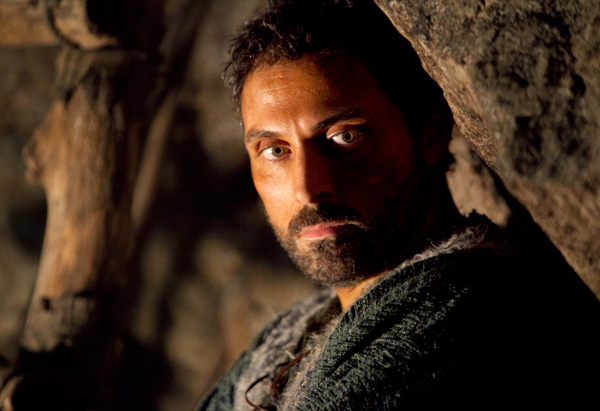 |
| The Rufous Rufus Sewell. That just feels right. |
Each Tuesday, we’ll offer up a Superior Word for the edification of our Superior Readers, via the volumes of the inimitable Peter Bowler. You can purchase all or any of the four Superior Person’s Books of Words from the Godine website. Rufous appears in the third.
Monday, August 23, 2010
Cheyenne Madonna @ Pasatiempo

at The Santa Fe New Mexican
“Chuculate presents a profound disconnect between the mythology of Indian art and the present-day reality of Indian artists, who rarely get to be artists without the cultural qualifier. He also lays bare the effects of wide-spread multi-generational addiction without making excuses for the way his characters treat each other. There are no saints in here, and no demons, either. Cheyenne Madonna is a fantastic debut.”
Buy Cheyenne Madonna from the Black Sparrow website!
Friday, August 20, 2010
Slight Consolation
 | ||
| Seriously, how do you even turn this thing on? |
“The story begins with money. Johannes Gutenberg did not find a way to profit from his technical achievements. The Gutenberg Bible, a gigantic project, required large amounts of capital that needed replenishing over time, long before there was any hope of profit. The finished product inspired awe, but the print run was 180 copies. Gutenberg “died bankrupt and disappointed.”
Nor was he alone. Apparently, it took decades before some people figured out how to make money from this remarkable invention. For decades after Gutenberg, it was not even clear that print would become a success. How do you market books? How many should you run off at one time? Piracy was a problem, as were texts changed, mutilated or combined in unauthorized editions. Many printers were ruined, trying to exploit the new medium.”
Thursday, August 19, 2010
A Radical Mention: Robert Leonard Reid
 |
| Robert Leonard Reid |
There are third party candidates, but my favorite for that role is too busy with his own writing and musical career to jumble his life by stumbling into the political maelstrom. I speak of the aforementioned friend, Carson City’s Robert Leonard Reid (no relation to Harry that I can discern).
Bob Reid is a bleeding heart booster of an ecological approach to existence, something captured with aplomb in his latest book: Arctic Circle: Birth and Rebirth in the Land of the Caribou. In it he recounts an Arctic trip to watch caribou migrate.
And he quotes the great naturalist Wendell Berry. For me, it made a pertinent point regarding current politics both nationally and in Nevada.
“In his poem ‘The Peace of Wild Things,’” writes Reid, “Wendell Berry offers as an antidote to the dissonance of daily life the ‘still water’ of the natural world:
 ‘When despair for the world grows in me/ and I wake in the night at the least sound/ in fear of what my life and my children’s lives may be,/ I go and lie down where the wood drake/ rests in his beauty on the water, and the great heron feeds./ I come into the peace of wild things … ’
“Nature has the capacity to heal the frazzled soul, Berry reminds us, bringing with it freedom and ‘the grace of the world,’” Bob Reid concluded.
Bob Reid also wrote the musical revue “I Say Nevada!” that was presented in Carson City in 2008. An updated “bailout version” is scheduled for this autumn. In it, songs make sardonic humor romp. In one, Harry Reid is satirized for the heartthrob he is (NOT).
Tuesday, August 17, 2010
Superior Person's Tuesday
Quietus n. A blow or other action bringing about death; a coup de grace. As in Hamlet: "his quietus make / With a bare bodkin...." (a bodkin being a pin or other pointed instrument such as a stiletto). A suggestively gentle word for a grim thing. "Time for your quietus now, children," you gently say, as you usher your visitors' uncontrolled little offspring out of the lounge room; "I have some lovely plastic bags for you to play with in the rumpus room."
Each Tuesday, we’ll offer up a Superior Word for the edification of our Superior Readers, via the volumes of the inimitable Peter Bowler. You can purchase all or any of the four Superior Person’s Books of Words from the Godine website. Quietus appears in the third.
Each Tuesday, we’ll offer up a Superior Word for the edification of our Superior Readers, via the volumes of the inimitable Peter Bowler. You can purchase all or any of the four Superior Person’s Books of Words from the Godine website. Quietus appears in the third.
Monday, August 16, 2010


Thursday, August 12, 2010
A Giveaway Party

Just stop by www.lonelyphonebooth.com and leave a comment
for a chance to win a free copy of The Lonely Phone Booth!
for a chance to win a free copy of The Lonely Phone Booth!
It's that easy. We swear.
Wednesday, August 11, 2010
Bookfuturism
at The Atlantic, Tim Carmody writes about “bookfuturism:”
A bookfuturist manifesto could never really be like an avant-garde or political manifesto, partly because the whole idea of bookfuturism is to critically unravel these contradictions, rather than stake out definite positions that we'd cling to no matter what. For instance, when Amazon's Kindle first came out, I was completely of the mind that these text-only files cheaply mocked the experience of reading a book without actually including all its rich physicality, or trying to create a new, specifically digital experience. Now, as the whole industry's moved towards multimedia tablets and touch interfaces, I find myself thinking, "you know, maybe just focusing on text, and making that experience as useful and enjoyable as possible, is a really good idea. Text and textual interfaces are incredibly resilient and powerful. Bring back the command line!”
Bookfuturism turns out to be not just about books as such, but a kind of aesthetic and culture of reading, literacy, history, in connection with (only rarely in opposition to) other kinds of media culture. And reading here would also obviously include newspapers and magazines, and even things like maps and advertisements and data visualizations, plus whatever's displayed on the different screens most of us look at all day at home or work. What does it mean to live in this hyperliterate world? How do we make sense of it? There I think we need to actually articulate something like Jason Kottke's motto: "Liberal Arts 2.0."
A bookfuturist manifesto could never really be like an avant-garde or political manifesto, partly because the whole idea of bookfuturism is to critically unravel these contradictions, rather than stake out definite positions that we'd cling to no matter what. For instance, when Amazon's Kindle first came out, I was completely of the mind that these text-only files cheaply mocked the experience of reading a book without actually including all its rich physicality, or trying to create a new, specifically digital experience. Now, as the whole industry's moved towards multimedia tablets and touch interfaces, I find myself thinking, "you know, maybe just focusing on text, and making that experience as useful and enjoyable as possible, is a really good idea. Text and textual interfaces are incredibly resilient and powerful. Bring back the command line!”
Bookfuturism turns out to be not just about books as such, but a kind of aesthetic and culture of reading, literacy, history, in connection with (only rarely in opposition to) other kinds of media culture. And reading here would also obviously include newspapers and magazines, and even things like maps and advertisements and data visualizations, plus whatever's displayed on the different screens most of us look at all day at home or work. What does it mean to live in this hyperliterate world? How do we make sense of it? There I think we need to actually articulate something like Jason Kottke's motto: "Liberal Arts 2.0."
Tuesday, August 10, 2010
Superior Person's Tuesday
Paracme n. The stage after one’s peak, when decline and senescence set it. “What an idea, Professor! You are indeed at the paracme of your powers!”
Each Tuesday, we’ll offer up a Superior Word for the edification of our Superior Readers, via the volumes of the inimitable Peter Bowler. You can purchase all or any of the four Superior Person’s Books of Words from the Godine website. Paracme appears in the second.
 |
| “How can I incorporate more killer trees?” |
Each Tuesday, we’ll offer up a Superior Word for the edification of our Superior Readers, via the volumes of the inimitable Peter Bowler. You can purchase all or any of the four Superior Person’s Books of Words from the Godine website. Paracme appears in the second.
Aram Saroyan & David Godine @ Skylight Books

Subscribe to:
Posts (Atom)